

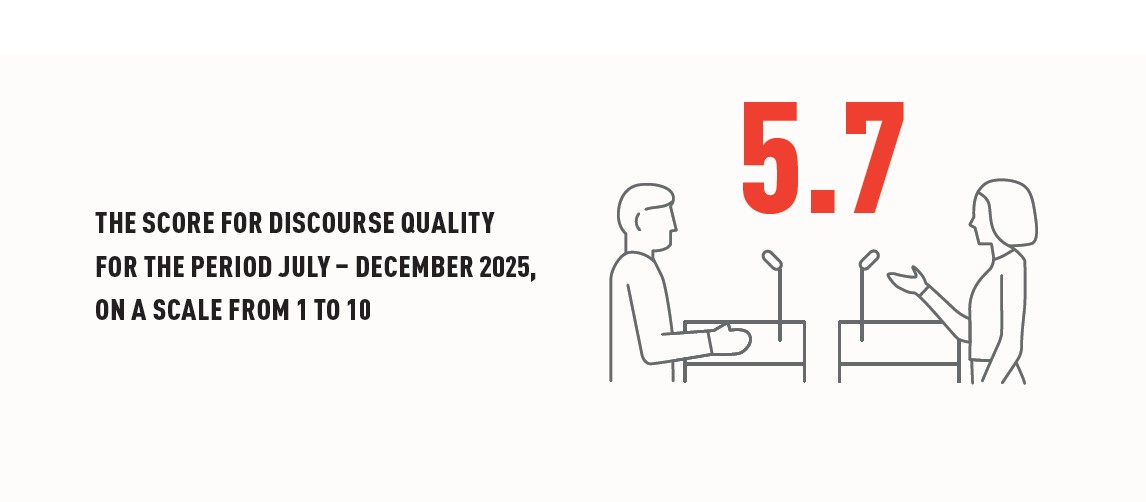
The report indicates a relatively low level of debate quality in the Parliament for the current mandate, and confirming that there is significant room for improvement. The average debate quality score for the first half of 2025 is 5.7 on a scale of 1-10. This represents no change from the previous monitoring period (January-June 2025) but a slight improvement (+.2) compared to the initial monitoring period (July – December 2024) of 5.5.
In addition to measuring the quality of the debate, MPs’ activity was also assessed on how often they spoke and the duration of their speeches.
Among the MPs who most frequently took the floor, seven were from the opposition and three from the majority. Among the MPs who spoke for the longest duration, eight were from the opposition, and two were from the majority. The three MPs who both spoke most frequently and spent the longest time at the parliamentary rostrum were Sali Murati, Fatmir Bitiki, and Jovanka Trenchevska. Among the ten MPs who most frequently took the floor and the ten who spent the longest time at the rostrum during the monitoring period, there were four women and seven men.
In 21% of analysed debates, participants made no arguments, and in 49% of analysed debates, they made weak arguments, meaning that speakers provided explanations of their positions that were insufficient to be considered a fully developed argument. In 21% of analysed debates, speakers used at least one argument to substantiate their position. The level of argumentation in 2025 shows a slight improvement compared to the second half of 2024 and to 2023. Argumentation was significantly lower in replies and counter-replies than in substantive speeches, which considerably diminishes the quality of debate in the Parliament.
With regard to how MPs respond to arguments presented by other MPs, the monitoring indicates that MPs addressed those arguments adequately in only 10% of their speeches, meaning that the MP responded directly to points previously raised by another participant in the debate. In contrast to previous monitoring periods, which recorded a continuous trend of improvement, 10% represents a decline from the 14% of adequately addressed arguments in the previous reporting period.
MPs from the parliamentary majority did not refer either to the arguments of interlocutors13 (78%) or to their personality14 (78%) in the large majority of their speeches. This relationship is almost at the same level as in the previous monitoring period.
Monitoring also focused on the review of four reports submitted to the Parliament15 by independent and regulatory bodies. Of the four reports, three were subject to weak discussion, while one was not discussed at all, indicating a lack of substantial parliamentary oversight in this segment.
Three regular and two additional sessions of parliamentary questions for the opposition were held. The regular parliamentary question sessions scheduled for September and October were not conducted due to a decision by MPs not to sit during the local election campaign period.
The report also confirms the low level of MPs’ attention towards the rights of marginalised groups across all monitoring periods. In 79% of their discussions, MPs do not refer to the rights of marginalised persons. While this represents an improvement from the previous reporting period, when this figure reached 87%, MPs consistently do not address the rights of marginalised groups unless a specific law or agenda item related to those rights is under discussion.
Recommendations for improving the quality of parliamentary debate:
- Enhance the quality and level of argumentation of parliamentary debate through systematic improvement of MPs’ preparation and presentations.
- Strengthen MPs’ knowledge, debating, and oratory skills through continuous training and education, while ensuring systematic support for newly elected MPs, with a particular focus on argument-based speaking and the effective use of available analytical tools.
- Make more intensive and effective use of the services, analyses, and research provided by the Parliamentary Institute and the Parliamentary Budget Office.
- Actively apply Regulatory Impact Assessment (RIA) in the work of the Parliament, including for draft laws submitted by MPs.
- Ensure that shortened legislative procedures are used carefully and only in limited and justified contexts, so as not to restrict parliamentary debate.
- Strengthen the oversight role of the Parliament through more active monitoring and evaluation of the Government’s strategic policies and reform processes.
- Encourage greater involvement of citizens, civil society organisations, and the expert community in the legislative process, including through legislative public hearings.
- Promote the use of examples drawn from citizens’ experiences, interests, and needs in parliamentary debates, and to actively respond to discriminatory and sexist speech.
- Apply a calendar of parliamentary and committee sessions in order to increase predictability, improve preparation and enhance the quality of parliamentary debate.
Read more:
PARLIAMENT WATCH: MONITORING REPORT ON THE DEBATE QUALITY IN THE PARLIAMENT (JULY – DECEMBER 2025)
This publication has been prepared within the framework of the Parliamentary Support Programme (PSP), a project of the Government of Switzerland under the auspices of the Parliament of the Republic of North Macedonia. The PSP is implemented by the National Democratic Institute (NDI), the Institute for Democracy “Societas Civilis” – Skopje (IDSCS) and the Center for Change Management (CCM). The opinions, views and content expressed do not reflect the views of the project, the donor and the implementer.
Настани поврзани со проектот



PARLIAMENT WATCH: MONITORING REPORT ON THE DEBATE QUALITY IN THE PARLIAMENT (JULY – DECEMBER 2023)
03.06.2024The report shows the relatively low level of debate quality...

Harmonization of national legislation with EU legislation: Comparative overview of North Macedonia with Albania and Serbia
15.01.2024The process of harmonization between the European Union acquis (hereinafter:...

PARLIAMENT WATCH: MONITORING REPORT ON THE DEBATE QUALITY IN THE PARLIAMENT (JANUARY – JUNE 2023)
15.08.2023The report shows the relatively low level of debate quality...

A gender-sensitive Assembly and gender equality on the political stage: An overview of the current situation in North Macedonia
14.07.2023The North Macedonia Gender Equality Index score for 2022 is...

Parliament Watch: Citizen Perceptions of the Work of the Assembly of the Republic of North Macedonia (2023)
01.06.2023Between February and April 2023, the Institute for Democracy Societas...

Parliament Watch: Monitoring report on the debate quality in the Parliament (July – December 2022)
17.02.2023Parliament Watch: Monitoring report on the debate quality in the...

Quality of Debate: Is the untimely scheduling of sessions affecting the quality of the debate in the Assembly?
18.01.2023Pursuant to Article 67 of the Rules of Procedure of...

Focus Group Research: Public Perception on Trust in Political Parties, Public Institutions and Quality of Life in North Macedonia
06.12.2022In September 2022, the Institute for Democracy "Societas Civilis" Skopje,...

Towards a more efficient and constructive Assembly through amendments to the Rules of Procedure
17.10.2022The active participation of MPs in parliamentary life is of...

Parliament Watch: Monitoring report on the debate quality in the Parliament (January – June 2022)
24.08.2022Parliament Watch: Monitoring report on the debate quality in the...

Parliament Watch: Citizens’ perception about the work of the Assembly of the Republic of North Macedonia – 2022
12.07.2022Parliament Watch: Citizens’ perception about the work of the Assembly...

Parliamentary questions: What’s the level of argumentation and what did MPs ask the most? (January – December 2021)
26.05.2022Parliamentary questions: What’s the level of argumentation and what did...

Parliament Watch: Monitoring report on the debate quality in the Parliament (July – December 2021)
08.02.2022Parliament Watch: Monitoring report on the debate quality in the...

Assembly 2020-2024: Who represents the citizens?
27.12.2021Assembly 2020-2024: Who represents the citizens?

Openness of the Assembly: The Extent to Which the Public is Informed About and Involved in the Work of the MPs
13.12.2021Openness of the Assembly: The Extent to Which the Public...

Debate Quality in Parliament – a Brief Overview of the Debate Quality in the Period Between 2020 and 2021
01.10.2021Debate Quality in Parliament - a Brief Overview of the...

Parliament Watch: Monitoring report on the debate quality in the Parliament (January – June 2021)
18.08.2021Parliament Watch: Monitoring report on the debate quality in the...

July 2020 – July 2021: One year after the parliamentary elections, how do the citizens perceive the political influence and the openness of the current composition of the Assembly?
26.07.2021July 2020 - July 2021: One year after the parliamentary...

Representation of the Interests of the Citizens by the Members of Parliament – Truth or Myth
23.06.2021According to data from field surveys conducted in 2018-2021...

Citizens’ information about the work of the Assembly of the Republic of North Macedonia
26.04.2021The source of legitimacy of MPs to hold sessions and...

Parliament Watch: Monitoring report on the debate quality in the Parliament (August – December 2020)
28.01.2021Parliament Watch: Monitoring report on the debate quality in the...

What is the general perception of the citizens’ about the Assembly of the Republic of North Macedonia?
18.01.2021What is the general perception of the citizens’ about the...

Quality of the discourse in the Assembly: Oversight hearing on the case of Eurostandard bank
14.12.2020Political control and oversight of the Government and other public...
Quality of the discourse in the Assembly: Oversight hearing on the case of Eurostandard bank
14.12.2020Quality of the discourse in the Assembly: Oversight hearing on...

Women in Parliamentary Committees: A New Term, but the Same Old Practice
30.11.2020On July 15, 2020, the new members of the Assembly...

Young people and politics in North Macedonia: How is the work of the Assembly perceived?
17.11.2020Young people and politics in North Macedonia: How is the...

Parliament Watch: Results from the field survey on citizens’ perceptions about the work of Parliament (February 17th – March 6th, 2020)
05.11.2020Parliament Watch: Results from the field survey on citizens’ perceptions...

The citizens and the Assembly of North Macedonia: Trust on shaky ground
04.11.2020This analysis provides a comparative overview of the trust that...

Substantive or sterile: Parliamentary representation of women in the Republic of North Macedonia (1990 – 2020)
10.08.2020Substantive or sterile: Parliamentary representation of women in the Republic...

Empty discourse or speech based on clear justification: Comparative analysis of the level of argumentation of discourse in the parliaments of North Macedonia, Slovenia, and the European Parliament
09.07.2020Empty discourse or speech based on clear justification: Comparative analysis...

Parliamentary Support Program (PSP)
02.06.2020
Switzerland and North Macedonia Assembly announce 10 year partnership
10.07.2019The Swiss Parliament Support Programme builds on the successful cooperation...