

The report indicates a relatively low level of debate quality in the Parliament for the current mandate, confirming that there is significant room for improvement. The average debate quality score for the first half of 2025 is 5.7 on a scale of 1-10. This represents a slight improvement (+.2) compared to the previous monitoring period (July – December 2024) of 5.5.
The activity of MPs was monitored by measuring how often they spoke and the duration of their speeches.
The most active speakers included seven MPs from the opposition and three from the majority. The same ratio of seven opposition and three majority MPs is also observed when measuring the length of speeches. The three most active MPs in both parameters are Sali Murati, Jovanka Trenchevska, and Bojan Stojanoski.
Although women’s participation in discussions has increased by 3% to 37%, it is still below the levels of 2022 and 2023, when it exceeded 40%.
In 27% of all analyzed discussions, participants made no arguments, while in 54% of the analyzed discussions, they had poor arguments, that is, the speakers offered an explanation of their positions that was insufficient to be considered a full argument. The level of argumentation has slightly improved compared to the second half of 2023 and 2024, which corresponded with the previous parliamentary composition.
During the monitoring period, five regular and three additional parliamentary question sessions of parliamentary questions were held for the opposition. The session scheduled for March 2025 was not held as a result of national mourning following the tragedy in Kochani.
In terms of how MPs respond to arguments presented by their colleagues, the monitoring found that in 14% of speeches, MPs addressed the arguments appropriately by directly responding to arguments previously made by another participant. In this reporting period, no change of attitude was observed among the MPs in response to better arguments from their interlocutors, which is at the same level as the discussions monitored during the previous parliamentary composition.
From January to June 2025, monitoring also focused on the review of 15 reports submitted to the Parliament by independent and regulatory bodies. Of the 15 reports, nine reports were not discussed in plenary and committee sessions, two reports garnered considerably short discussions, and the remaining four reports were discussed in both committee and plenary sessions, and they underwent a certain level of control.
During this monitoring period, MPs in over three-quarters of their speeches did not engage with either the arguments of the interlocutor from another political option12 (76%) or towards their personality (80%).
This relationship differs from the previous monitoring period, which was during the previous parliamentary composition, when there was a higher percentage (79%) of interlocutor arguments not being addressed.
In addition, it can be concluded that, in the rest of their speeches, the MPs refer less to the personal characteristics of the interlocutors and more to the essential consideration of their arguments.
The report also confirms a consistently low level of MP attention towards the rights of marginalized groups, a trend consistent across all periods of monitoring. In 86% of their discussions, MPs do not refer to the rights of marginalized groups, unless a specific law or agenda topic is directly related to their rights. Although MPs rarely refer to the rights of marginalized groups and communities, female MPs refer to these communities more often than their fellow male MPs.
Read the report:
Parliament Watch: Monitoring Report on the Debate Quality in the Parliament (January – June 2025)
Настани поврзани со проектот
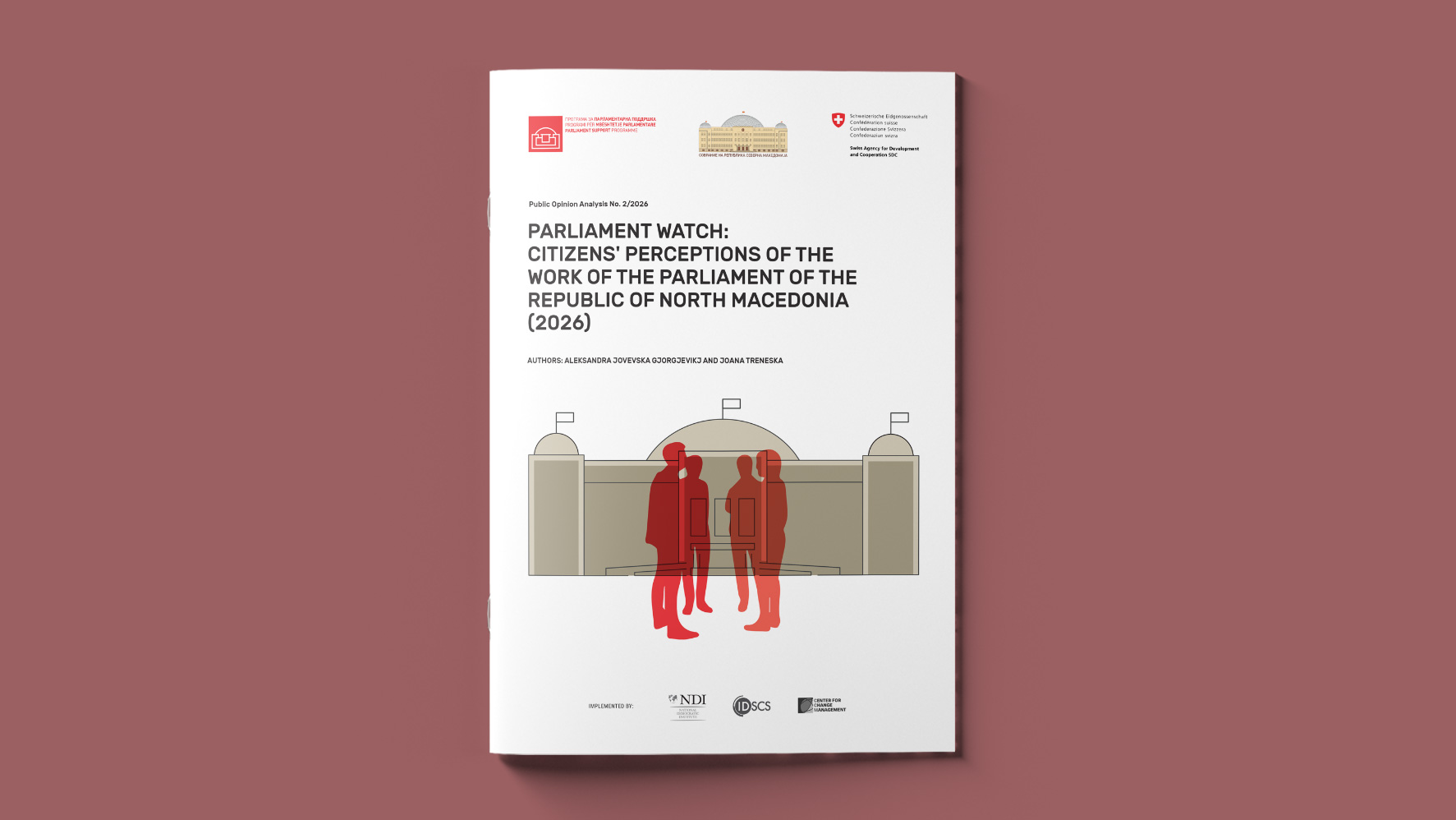



PARLIAMENT WATCH: MONITORING REPORT ON THE DEBATE QUALITY IN THE PARLIAMENT (JULY – DECEMBER 2023)
03.06.2024The report shows the relatively low level of debate quality...

Harmonization of national legislation with EU legislation: Comparative overview of North Macedonia with Albania and Serbia
15.01.2024The process of harmonization between the European Union acquis (hereinafter:...

PARLIAMENT WATCH: MONITORING REPORT ON THE DEBATE QUALITY IN THE PARLIAMENT (JANUARY – JUNE 2023)
15.08.2023The report shows the relatively low level of debate quality...

A gender-sensitive Assembly and gender equality on the political stage: An overview of the current situation in North Macedonia
14.07.2023The North Macedonia Gender Equality Index score for 2022 is...

Parliament Watch: Citizen Perceptions of the Work of the Assembly of the Republic of North Macedonia (2023)
01.06.2023Between February and April 2023, the Institute for Democracy Societas...

Parliament Watch: Monitoring report on the debate quality in the Parliament (July – December 2022)
17.02.2023Parliament Watch: Monitoring report on the debate quality in the...

Quality of Debate: Is the untimely scheduling of sessions affecting the quality of the debate in the Assembly?
18.01.2023Pursuant to Article 67 of the Rules of Procedure of...

Focus Group Research: Public Perception on Trust in Political Parties, Public Institutions and Quality of Life in North Macedonia
06.12.2022In September 2022, the Institute for Democracy "Societas Civilis" Skopje,...

Towards a more efficient and constructive Assembly through amendments to the Rules of Procedure
17.10.2022The active participation of MPs in parliamentary life is of...

Parliament Watch: Monitoring report on the debate quality in the Parliament (January – June 2022)
24.08.2022Parliament Watch: Monitoring report on the debate quality in the...

Parliament Watch: Citizens’ perception about the work of the Assembly of the Republic of North Macedonia – 2022
12.07.2022Parliament Watch: Citizens’ perception about the work of the Assembly...

Parliamentary questions: What’s the level of argumentation and what did MPs ask the most? (January – December 2021)
26.05.2022Parliamentary questions: What’s the level of argumentation and what did...

Parliament Watch: Monitoring report on the debate quality in the Parliament (July – December 2021)
08.02.2022Parliament Watch: Monitoring report on the debate quality in the...

Assembly 2020-2024: Who represents the citizens?
27.12.2021Assembly 2020-2024: Who represents the citizens?

Openness of the Assembly: The Extent to Which the Public is Informed About and Involved in the Work of the MPs
13.12.2021Openness of the Assembly: The Extent to Which the Public...

Debate Quality in Parliament – a Brief Overview of the Debate Quality in the Period Between 2020 and 2021
01.10.2021Debate Quality in Parliament - a Brief Overview of the...

Parliament Watch: Monitoring report on the debate quality in the Parliament (January – June 2021)
18.08.2021Parliament Watch: Monitoring report on the debate quality in the...

July 2020 – July 2021: One year after the parliamentary elections, how do the citizens perceive the political influence and the openness of the current composition of the Assembly?
26.07.2021July 2020 - July 2021: One year after the parliamentary...

Representation of the Interests of the Citizens by the Members of Parliament – Truth or Myth
23.06.2021According to data from field surveys conducted in 2018-2021...

Citizens’ information about the work of the Assembly of the Republic of North Macedonia
26.04.2021The source of legitimacy of MPs to hold sessions and...

Parliament Watch: Monitoring report on the debate quality in the Parliament (August – December 2020)
28.01.2021Parliament Watch: Monitoring report on the debate quality in the...

What is the general perception of the citizens’ about the Assembly of the Republic of North Macedonia?
18.01.2021What is the general perception of the citizens’ about the...

Quality of the discourse in the Assembly: Oversight hearing on the case of Eurostandard bank
14.12.2020Political control and oversight of the Government and other public...
Quality of the discourse in the Assembly: Oversight hearing on the case of Eurostandard bank
14.12.2020Quality of the discourse in the Assembly: Oversight hearing on...

Women in Parliamentary Committees: A New Term, but the Same Old Practice
30.11.2020On July 15, 2020, the new members of the Assembly...

Young people and politics in North Macedonia: How is the work of the Assembly perceived?
17.11.2020Young people and politics in North Macedonia: How is the...

Parliament Watch: Results from the field survey on citizens’ perceptions about the work of Parliament (February 17th – March 6th, 2020)
05.11.2020Parliament Watch: Results from the field survey on citizens’ perceptions...

The citizens and the Assembly of North Macedonia: Trust on shaky ground
04.11.2020This analysis provides a comparative overview of the trust that...

Substantive or sterile: Parliamentary representation of women in the Republic of North Macedonia (1990 – 2020)
10.08.2020Substantive or sterile: Parliamentary representation of women in the Republic...

Empty discourse or speech based on clear justification: Comparative analysis of the level of argumentation of discourse in the parliaments of North Macedonia, Slovenia, and the European Parliament
09.07.2020Empty discourse or speech based on clear justification: Comparative analysis...

Parliamentary Support Program (PSP)
02.06.2020
Switzerland and North Macedonia Assembly announce 10 year partnership
10.07.2019The Swiss Parliament Support Programme builds on the successful cooperation...