


The Institute for Democracy “Societas Civilis” – Skopje, within the framework of the Parliament Support Program (PSP), in the period from March 26 to April 12, 2024, conducted a field survey to better investigate the public perception of the Parliament’s work.
The analysis of public opinion “Parliament Watch: Citizens’ perceptions of the work of the Assembly of the Republic of North Macedonia (2024)”, analyzes the thoughts and experiences of the citizens in relation to all the functions of the Assembly, control and supervision over the executive power, the public in the work, who the MPs represent in the Parliament, the parliamentary debate and reforms, trust in the Parliament compared to other institutions, etc.
The research conducted in 2024 shows that the citizen perception of the work of the Assembly is, generally, in line with the opinion expressed in the last three years, with slight improvements in several areas. On the scale from 1 – worst, to 5 – best, in 2024 the citizens evaluated the work of the Assembly with an average score of 2.3, which is an almost insignificant increase of 0.1 point compared to the score given by the citizens in 2023, which was 2.2.
HOW WELL ARE THE CITIZENS INFORMED ABOUT THE WORK OF THE ASSEMBLY
As most typical characteristic of the work of the Assembly in 2023, the citizens singled out the work of the Inquiry Committee on the scandal in PHI University Clinic for Radiotherapy and Oncology, the adoption of the Budget for 2024 as well as the changes and amendments of the Law on Games of Chance. However, the majority of citizens also stated that they were not satisfied with the way the Assembly performed its functions in the mentioned cases. Television remains the most popular channel among citizens for obtaining information about the work of the Assembly, while the Assembly TV Channel and the website remain little used as official tools for being informed about the Assembly.
ASSEMBLY CONTROL AND OVERSIGHT OVER THE EXECUTIVE POWER
The perception of the majority of citizens is that the Assembly does not fully exercise its constitutional authority to control the Government, that is, a quarter (23%) of the respondents believe that the Government has full control over the Assembly. When talking about the MP questions as one of the tools for exercising oversight over the executive power, citizens are divided as to whether they are used appropriately or to criticize or advertise. Most of the citizens (91%) do not remember which other oversight tool the Assembly used in the last year. The citizens who still remembered of a particular case, most often mention the work of the Inquiry Committee on the events that happened at oncology.
FUNCTIONS OF THE ASSEMBLY
Most of the citizens have a perception that the MPs have a certain influence on the quality of laws. The adoption of laws with high quality, the oversight over the spending of the budget and the care for the implementation of the laws and policies are all pointed out as the most important functions of the Assembly by the majority of the citizens. However, the implementation of these functions by the Assembly has been assessed as unsatisfactory by the majority of citizens.
THE PUBLIC IN THE WORK OF THE ASSEMBLY
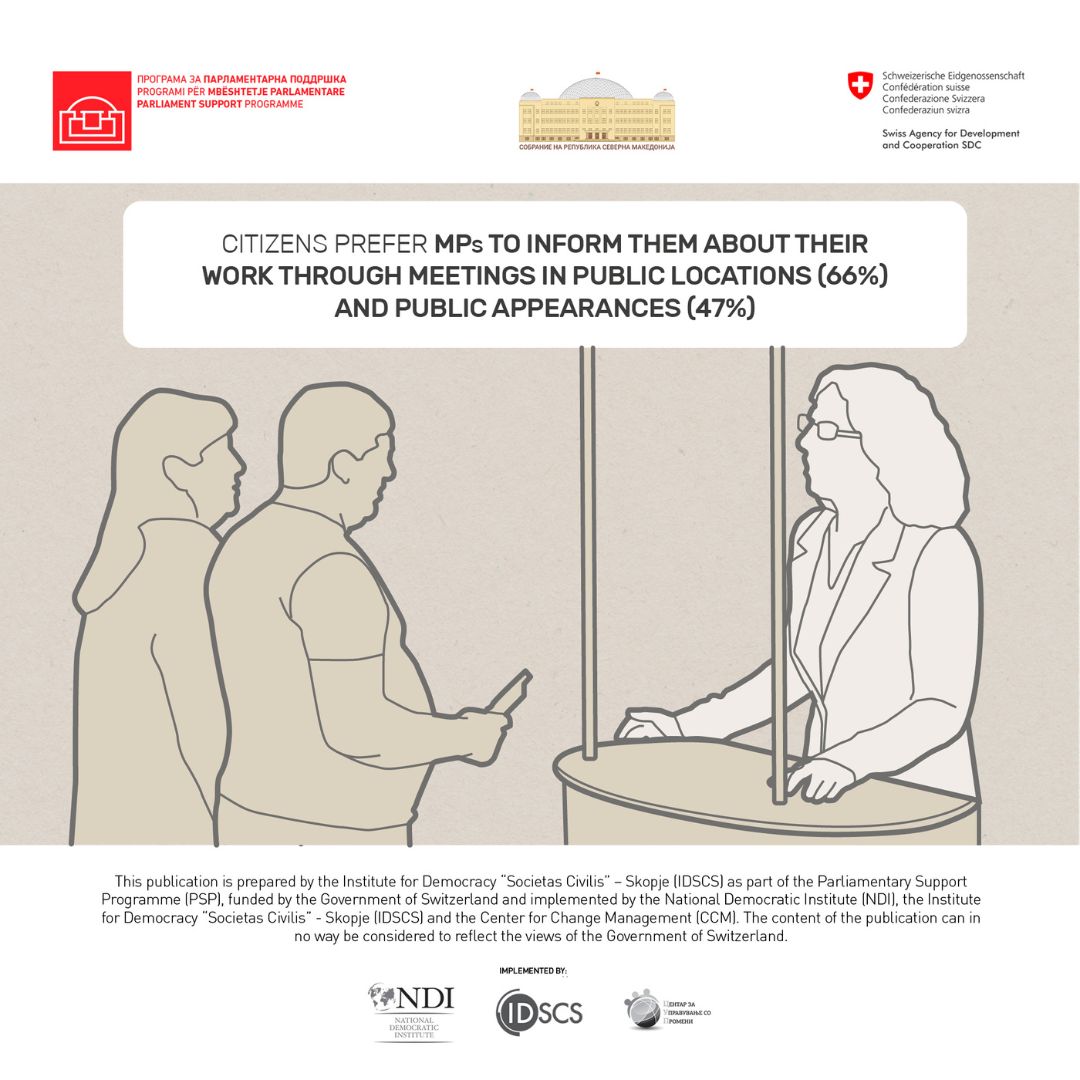
In terms of openness of the Assembly to the public, the majority of the respondents believe that the Assembly is fully or partially closed to the public. The majority of the citizens also believe that the MPs from their constituencies are not available for meetings with the citizens, that they do not sufficiently inform the citizens about their work, and they are not even informed about the local MP offices. Citizens remark that the MPs do not pay sufficient attention to the issues faced by the municipalities and the local communities. Most of the citizens stated that they have not been informed about the ways in which they can participate in the work of the Assembly, which has resulted in the fact that only a handful of respondents have attempted to participate in the work of the Assembly.
WHO ARE REPRESENTED IN THE ASSEMBLY BY THE MPs?
Respondents are relatively divided in terms of their impression about the degree to which the MPs represent the interests of citizens in the Assembly. On the other hand, most of them believe that the MPs always represent their personal interests, the interests of the political parties as well as the interests of the business sector. The respondents also believe that, in terms of marginalized groups, those that are best represented in the Assembly are social assistance beneficiaries, the LGBTI+ community and the Roma.
THE DEBATE IN THE ASSEMBLY
The perception of the majority of citizens is that neither the MPs from the government nor the MPs from the opposition do not take into account the arguments of their colleagues from the opposite camp. More than half of the respondents also believe that there is a desire for a compromise among the political parties in the interest of the citizens, but that such a compromise is rarely reached. In addition, more than two-thirds (69%) of the surveyed citizens have the impression that MPs often or always use language in which they belittle and degrade their political opponents based on their political, ethnic, religious and gender affiliation.
REFORMS
For half of the respondents the introduction of open lists, whereby in the parliamentary elections you would vote for a person, instead of a party list, would contribute to a more quality composition of the Assembly. Furthermore, half of the respondents also believe that it is important to establish multi-party groups in the Assembly in which MPs from different parties will unite around the same issues that are of particular interest to the citizens. Two priority topics for which such multi-party groups should be established in the Assembly that were indicated by the citizens are the youth and the issue of unemployed.
POLITICAL CONTEXT AND TRUST IN THE INSTITUTIONS
The number of citizens who believe that life in the country is moving in the wrong direction dominates over those who believe the opposite. On a scale from 1 – the lowest, to 10 – the highest, the citizens with the highest trust score rated the religious communities with an average score of 5.7 and the military with an average score of 5.4. The Public Prosecutor’s Office was scored 3.3 and the Judiciary with 3, which is the lowest average score among the institutions. The institutions holding legislative, executive and judicial power in the country were rated with average scores below 4: the President of the State – 3.8, the Assembly – 3.7 and the Government – 3.5. The citizens who rated their trust in the Assembly as 4 or lower say that «MPs do not work in the interest of the citizens, i.e. the state», «they do not work conscientiously and professionally» and «they adopt bad laws and laws that serve their personal interest». These citizens believe that it is, first of all, necessary for «the MPs to work in the interest of the citizens» and on the increase of the MP’s integrity, i.e. for the MPs to be honest, responsible and professional.
You can read the report here:
Настани поврзани со проектот



PARLIAMENT WATCH: MONITORING REPORT ON THE DEBATE QUALITY IN THE PARLIAMENT (JULY – DECEMBER 2023)
03.06.2024The report shows the relatively low level of debate quality...

Harmonization of national legislation with EU legislation: Comparative overview of North Macedonia with Albania and Serbia
15.01.2024The process of harmonization between the European Union acquis (hereinafter:...

PARLIAMENT WATCH: MONITORING REPORT ON THE DEBATE QUALITY IN THE PARLIAMENT (JANUARY – JUNE 2023)
15.08.2023The report shows the relatively low level of debate quality...

A gender-sensitive Assembly and gender equality on the political stage: An overview of the current situation in North Macedonia
14.07.2023The North Macedonia Gender Equality Index score for 2022 is...

Parliament Watch: Citizen Perceptions of the Work of the Assembly of the Republic of North Macedonia (2023)
01.06.2023Between February and April 2023, the Institute for Democracy Societas...

Parliament Watch: Monitoring report on the debate quality in the Parliament (July – December 2022)
17.02.2023Parliament Watch: Monitoring report on the debate quality in the...

Quality of Debate: Is the untimely scheduling of sessions affecting the quality of the debate in the Assembly?
18.01.2023Pursuant to Article 67 of the Rules of Procedure of...

Focus Group Research: Public Perception on Trust in Political Parties, Public Institutions and Quality of Life in North Macedonia
06.12.2022In September 2022, the Institute for Democracy "Societas Civilis" Skopje,...

Towards a more efficient and constructive Assembly through amendments to the Rules of Procedure
17.10.2022The active participation of MPs in parliamentary life is of...

Parliament Watch: Monitoring report on the debate quality in the Parliament (January – June 2022)
24.08.2022Parliament Watch: Monitoring report on the debate quality in the...

Parliament Watch: Citizens’ perception about the work of the Assembly of the Republic of North Macedonia – 2022
12.07.2022Parliament Watch: Citizens’ perception about the work of the Assembly...

Parliamentary questions: What’s the level of argumentation and what did MPs ask the most? (January – December 2021)
26.05.2022Parliamentary questions: What’s the level of argumentation and what did...

Parliament Watch: Monitoring report on the debate quality in the Parliament (July – December 2021)
08.02.2022Parliament Watch: Monitoring report on the debate quality in the...

Assembly 2020-2024: Who represents the citizens?
27.12.2021Assembly 2020-2024: Who represents the citizens?

Openness of the Assembly: The Extent to Which the Public is Informed About and Involved in the Work of the MPs
13.12.2021Openness of the Assembly: The Extent to Which the Public...

Debate Quality in Parliament – a Brief Overview of the Debate Quality in the Period Between 2020 and 2021
01.10.2021Debate Quality in Parliament - a Brief Overview of the...

Parliament Watch: Monitoring report on the debate quality in the Parliament (January – June 2021)
18.08.2021Parliament Watch: Monitoring report on the debate quality in the...

July 2020 – July 2021: One year after the parliamentary elections, how do the citizens perceive the political influence and the openness of the current composition of the Assembly?
26.07.2021July 2020 - July 2021: One year after the parliamentary...

Representation of the Interests of the Citizens by the Members of Parliament – Truth or Myth
23.06.2021According to data from field surveys conducted in 2018-2021...

Citizens’ information about the work of the Assembly of the Republic of North Macedonia
26.04.2021The source of legitimacy of MPs to hold sessions and...

Parliament Watch: Monitoring report on the debate quality in the Parliament (August – December 2020)
28.01.2021Parliament Watch: Monitoring report on the debate quality in the...

What is the general perception of the citizens’ about the Assembly of the Republic of North Macedonia?
18.01.2021What is the general perception of the citizens’ about the...

Quality of the discourse in the Assembly: Oversight hearing on the case of Eurostandard bank
14.12.2020Political control and oversight of the Government and other public...
Quality of the discourse in the Assembly: Oversight hearing on the case of Eurostandard bank
14.12.2020Quality of the discourse in the Assembly: Oversight hearing on...

Women in Parliamentary Committees: A New Term, but the Same Old Practice
30.11.2020On July 15, 2020, the new members of the Assembly...

Young people and politics in North Macedonia: How is the work of the Assembly perceived?
17.11.2020Young people and politics in North Macedonia: How is the...

Parliament Watch: Results from the field survey on citizens’ perceptions about the work of Parliament (February 17th – March 6th, 2020)
05.11.2020Parliament Watch: Results from the field survey on citizens’ perceptions...

The citizens and the Assembly of North Macedonia: Trust on shaky ground
04.11.2020This analysis provides a comparative overview of the trust that...

Substantive or sterile: Parliamentary representation of women in the Republic of North Macedonia (1990 – 2020)
10.08.2020Substantive or sterile: Parliamentary representation of women in the Republic...

Empty discourse or speech based on clear justification: Comparative analysis of the level of argumentation of discourse in the parliaments of North Macedonia, Slovenia, and the European Parliament
09.07.2020Empty discourse or speech based on clear justification: Comparative analysis...

Parliamentary Support Program (PSP)
02.06.2020
Switzerland and North Macedonia Assembly announce 10 year partnership
10.07.2019The Swiss Parliament Support Programme builds on the successful cooperation...