

The analysis of gender representation and the representation of marginalised groups in the Parliament of North Macedonia shows a multifaceted dynamic. Although female MPs make up 37% of the composition, their representation in working bodies and committees indicates thematic segregation: they are more present in committees that have a social character, while male MPs dominate in committees related to finance, security, and the economy.
This trend confirms the existence of a gender approach to the distribution of influence and duties in Parliament, perpetuating traditional gender social roles in the legislature as well.
Additionally, the analysis of parliamentary debates shows that the rights and needs of marginalised groups are rarely represented through discourse, with particularly low visibility of the LGBTI+ community, single parents and residents of rural areas.
Women MPs, although in smaller numbers, contribute significantly more to discussions related to these categories. This finding implies that increasing gender representation can have a broader positive effect on the inclusiveness of Parliament, as women more often bring the voices of socially vulnerable and underrepresented groups to the political agenda. At the same time, it points to the need for structural support and mechanisms that will encourage male MPs to take a more active role in advocating for these issues.
There are significant discrepancies between the public perception and the actual representation, indicating a perception gap regarding the representation of certain groups. While some citizens believe that certain communities – such as LGBTI+ people, or people with disabilities – are adequately represented in Parliament, empirical data and analysis of parliamentary discussions show that these groups hardly appear in the legislative discourse. This gap may stem from the public’s lack of awareness of the actual activities of the Parliament,
from media coverage that occasionally creates an impression of greater inclusiveness, but also from the fact that representation is often equated with symbolic, rather than substantive participation in political processes.
Read the report:
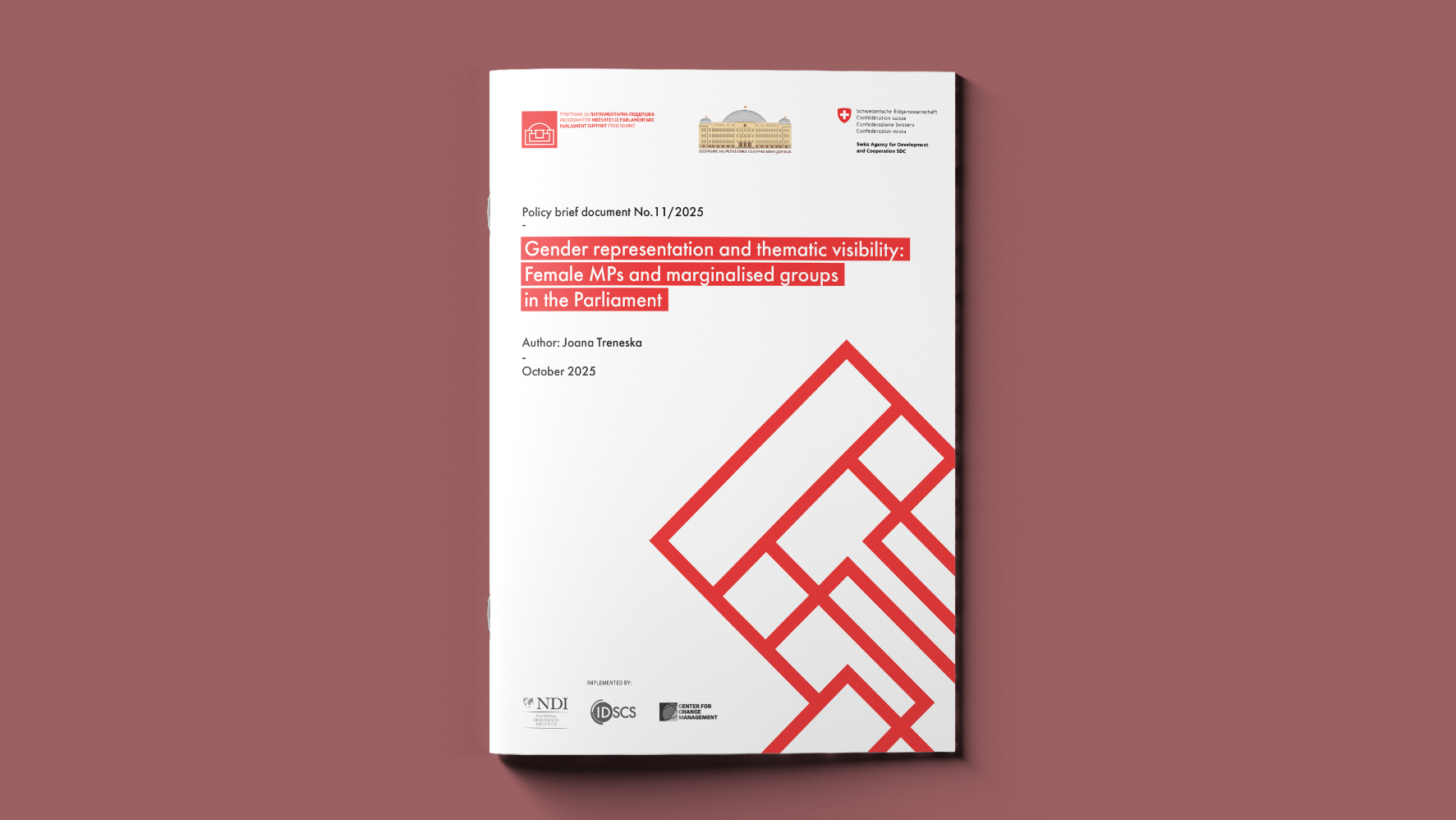
Gender representation and thematic visibility: Female MPs and marginalised groups in the Parliament
Настани поврзани со проектот


PARLIAMENT WATCH: MONITORING REPORT ON THE DEBATE QUALITY IN THE PARLIAMENT (JULY – DECEMBER 2023)
03.06.2024The report shows the relatively low level of debate quality...

Harmonization of national legislation with EU legislation: Comparative overview of North Macedonia with Albania and Serbia
15.01.2024The process of harmonization between the European Union acquis (hereinafter:...

PARLIAMENT WATCH: MONITORING REPORT ON THE DEBATE QUALITY IN THE PARLIAMENT (JANUARY – JUNE 2023)
15.08.2023The report shows the relatively low level of debate quality...

A gender-sensitive Assembly and gender equality on the political stage: An overview of the current situation in North Macedonia
14.07.2023The North Macedonia Gender Equality Index score for 2022 is...

Parliament Watch: Citizen Perceptions of the Work of the Assembly of the Republic of North Macedonia (2023)
01.06.2023Between February and April 2023, the Institute for Democracy Societas...

Parliament Watch: Monitoring report on the debate quality in the Parliament (July – December 2022)
17.02.2023Parliament Watch: Monitoring report on the debate quality in the...

Quality of Debate: Is the untimely scheduling of sessions affecting the quality of the debate in the Assembly?
18.01.2023Pursuant to Article 67 of the Rules of Procedure of...

Focus Group Research: Public Perception on Trust in Political Parties, Public Institutions and Quality of Life in North Macedonia
06.12.2022In September 2022, the Institute for Democracy "Societas Civilis" Skopje,...

Towards a more efficient and constructive Assembly through amendments to the Rules of Procedure
17.10.2022The active participation of MPs in parliamentary life is of...

Parliament Watch: Monitoring report on the debate quality in the Parliament (January – June 2022)
24.08.2022Parliament Watch: Monitoring report on the debate quality in the...

Parliament Watch: Citizens’ perception about the work of the Assembly of the Republic of North Macedonia – 2022
12.07.2022Parliament Watch: Citizens’ perception about the work of the Assembly...

Parliamentary questions: What’s the level of argumentation and what did MPs ask the most? (January – December 2021)
26.05.2022Parliamentary questions: What’s the level of argumentation and what did...

Parliament Watch: Monitoring report on the debate quality in the Parliament (July – December 2021)
08.02.2022Parliament Watch: Monitoring report on the debate quality in the...

Assembly 2020-2024: Who represents the citizens?
27.12.2021Assembly 2020-2024: Who represents the citizens?

Openness of the Assembly: The Extent to Which the Public is Informed About and Involved in the Work of the MPs
13.12.2021Openness of the Assembly: The Extent to Which the Public...

Debate Quality in Parliament – a Brief Overview of the Debate Quality in the Period Between 2020 and 2021
01.10.2021Debate Quality in Parliament - a Brief Overview of the...

Parliament Watch: Monitoring report on the debate quality in the Parliament (January – June 2021)
18.08.2021Parliament Watch: Monitoring report on the debate quality in the...

July 2020 – July 2021: One year after the parliamentary elections, how do the citizens perceive the political influence and the openness of the current composition of the Assembly?
26.07.2021July 2020 - July 2021: One year after the parliamentary...

Representation of the Interests of the Citizens by the Members of Parliament – Truth or Myth
23.06.2021According to data from field surveys conducted in 2018-2021...

Citizens’ information about the work of the Assembly of the Republic of North Macedonia
26.04.2021The source of legitimacy of MPs to hold sessions and...

Parliament Watch: Monitoring report on the debate quality in the Parliament (August – December 2020)
28.01.2021Parliament Watch: Monitoring report on the debate quality in the...

What is the general perception of the citizens’ about the Assembly of the Republic of North Macedonia?
18.01.2021What is the general perception of the citizens’ about the...

Quality of the discourse in the Assembly: Oversight hearing on the case of Eurostandard bank
14.12.2020Political control and oversight of the Government and other public...
Quality of the discourse in the Assembly: Oversight hearing on the case of Eurostandard bank
14.12.2020Quality of the discourse in the Assembly: Oversight hearing on...

Women in Parliamentary Committees: A New Term, but the Same Old Practice
30.11.2020On July 15, 2020, the new members of the Assembly...

Young people and politics in North Macedonia: How is the work of the Assembly perceived?
17.11.2020Young people and politics in North Macedonia: How is the...

Parliament Watch: Results from the field survey on citizens’ perceptions about the work of Parliament (February 17th – March 6th, 2020)
05.11.2020Parliament Watch: Results from the field survey on citizens’ perceptions...

The citizens and the Assembly of North Macedonia: Trust on shaky ground
04.11.2020This analysis provides a comparative overview of the trust that...

Substantive or sterile: Parliamentary representation of women in the Republic of North Macedonia (1990 – 2020)
10.08.2020Substantive or sterile: Parliamentary representation of women in the Republic...

Empty discourse or speech based on clear justification: Comparative analysis of the level of argumentation of discourse in the parliaments of North Macedonia, Slovenia, and the European Parliament
09.07.2020Empty discourse or speech based on clear justification: Comparative analysis...

Parliamentary Support Program (PSP)
02.06.2020
Switzerland and North Macedonia Assembly announce 10 year partnership
10.07.2019The Swiss Parliament Support Programme builds on the successful cooperation...