

The Institute for Democracy “Societas Civilis” – Skopje (IDSCS) and the Macedonian Centre for International Cooperation (MCIC) explored the views and perceptions of the citizens on topics from the domestic political scene, by asking questions related to the ratings of the political parties and the pre-election coalitions between the political parties. Authors of the report are Vladimir Misev and Bliznakovski Jovan from the Institute for Democracy.
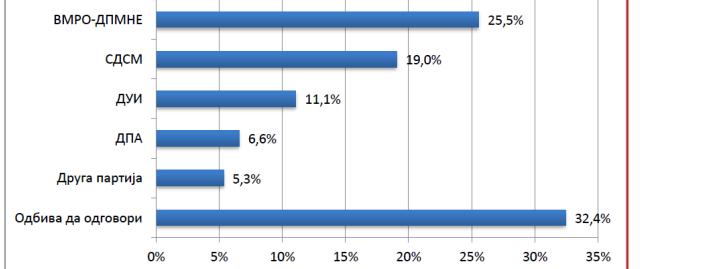
According to the research, the ruling party VMRO – DPMNE enjoys higher rating than the opposition party SDSM, 25.5% against 19% of the voters. Among the political parties with dominantly ethnic Albanian voters, DUI has the advantage over DPA with 11.1% against 6.6%. Almost one third of the respondents (32.4%) did not want to give any response as to for which party they are voting on the following elections.
One quarter from the respondents expect that VMRO-DPMNE will win the following elections (25.1%), while 15.2% of the total number of respondents expect a victory of SDSM.
Almost one third of the citizens (31.3%) would vote for a new political party. Nevertheless, 49.7 % would not give their vote for a new political option. This tendency is also equally prevailing among the two biggest ethnic communities in the state.
The citizens are largely skeptical that the pre-election coalition will bring any victory to the Opposition (51.5%). On the other hand, 20.8% from the citizens expect a victory of the Opposition. In addition, 56.2% of the citizens don’t approve the coalition between Ljubcho Georgievski and Branko Crvenkovski. The reasons for not approving such coalition are largely seen in the lack of credibility of these politicians (45.3%). Smaller part of the citizens (18.4%) approve the coalition between Ljubcho Georgievski and Branko Crvenkovski and the main reason behind that is the need of toppling the Government by any means.
On methodology: The research is conducted through a field survey – face to face in each household from 19 to 26 July 2012, on a representative example of 1.600 respondents. The population frame included persons above the age of 18, while the criteria for representation were: sex, ethnic affiliation, age and place of living. The field survey was conducted by the Institute for Democracy “Societas Civilis” – Skopje (IDSCS). All the results from this research are prone to a statistical error of 2.45%.
The entire report can be downloaded on the following link: