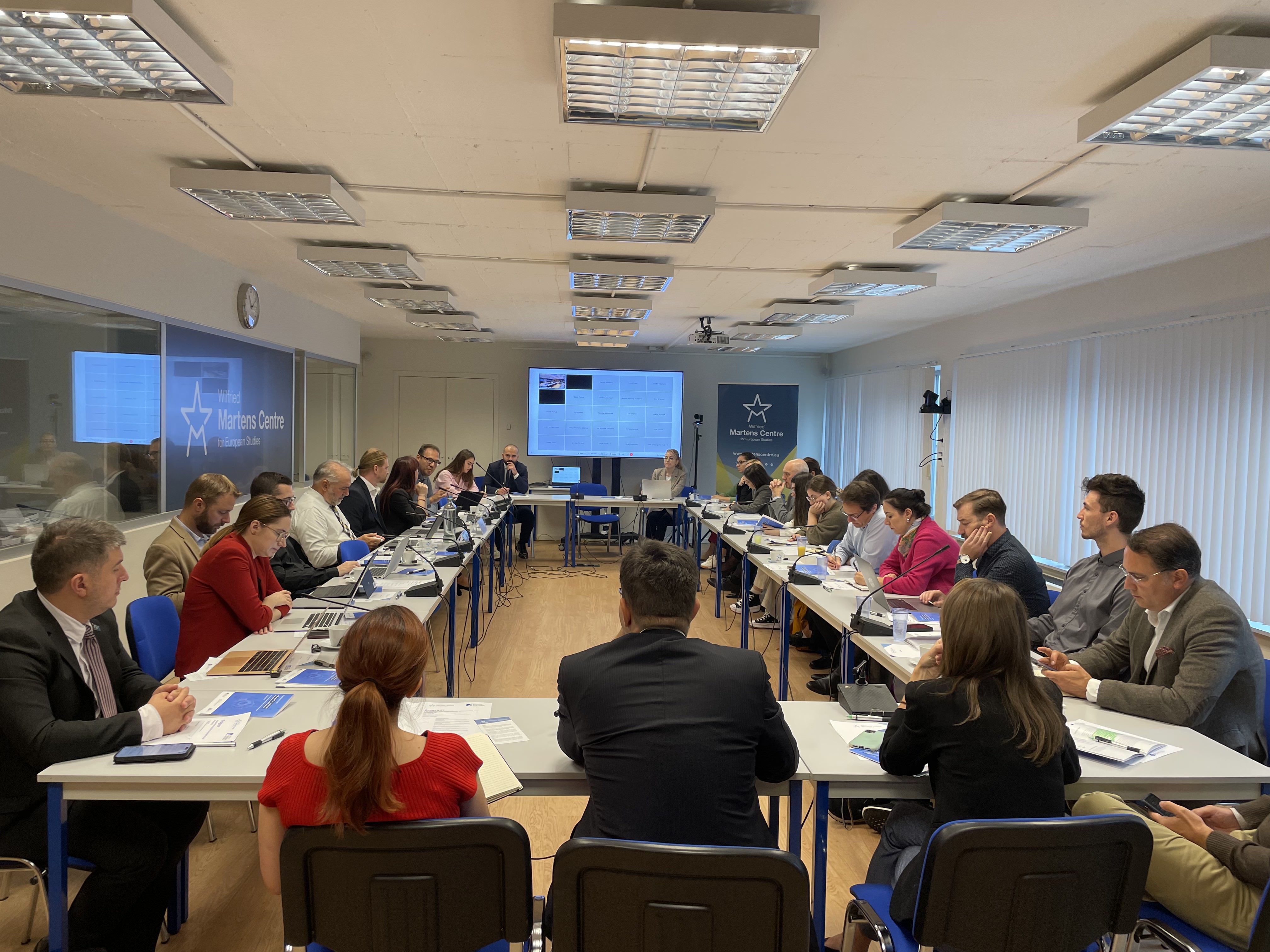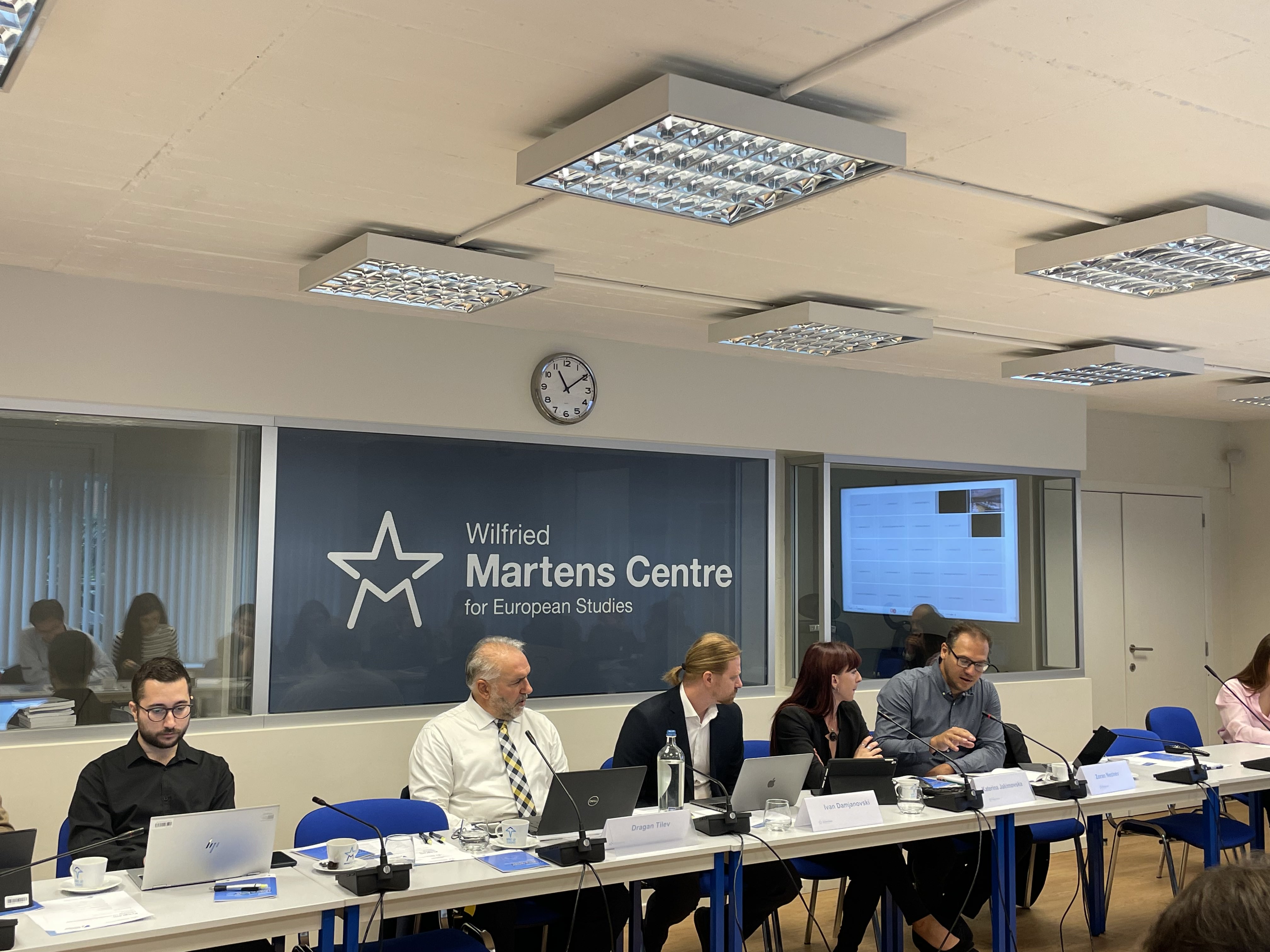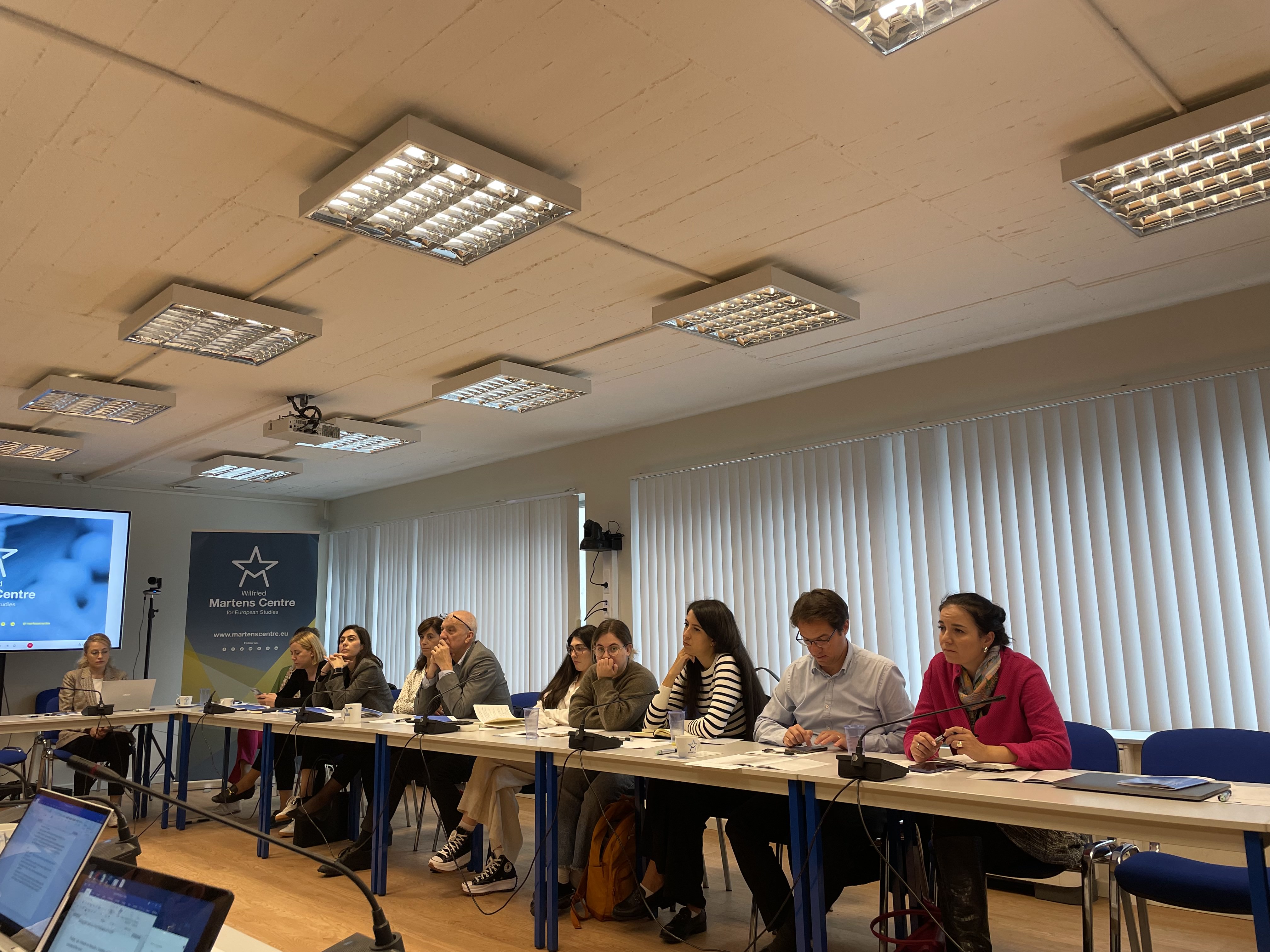
Wilfried Martens Centre for European Studies together with the Institute for Democracy Societas Civilis-Skopje and Konrad Adenauer Foundation organized an event for the promotion of the publication “A Blueprint for Accelerated Integration and Phasing-In” in the offices of Wilfred Martens Centre for European Studies in Brussels on Thursday, September 21, 2023.
The event was opened by Daniel Braun, Official Representative of the Konrad Adenauer Foundation in North Macedonia. Braun welcomed the attendees and gave his input on the future of the enlargement process.
“The path towards the European Union should be walked further, even when the perspective cannot be foreseen in a certain timeframe, any other opportunities or alternatives are not real nor suitable, and the countries should remain focused on paving the road to the EU. Although, full membership at this time seems difficult to get, integration through phasing-in can give the people and the countries incentives for the enlargement process” said Braun.
Following the opening speech, the authors have delved into the aspects of the policy brief including the political context, the policy perspective of the phasing-in concept and the technical details on the scope and depth to which the Western Balkan countries are participating in the decentralized EU agencies.
First, Zoran Nechev presented the wider context of the political climate in which the phasing-in concept has emerged.
“While enlargement is once again a prominent topic, there’s a crucial need for a structured approach. Regional cooperation holds significant importance, yet disparities among the member states persist. What we emphasize isn’t a novelty, but rather a provision outlined in the New Methodology. Despite its promotion in 2020, we’re still awaiting clear directives on the concept of ‘phasing in’ and the specific areas in which it can be applied”, stated Nechev.
Second, Dragan Tilev elaborated on the policy perspective of the phasing-in instrument.
“In our paper, we advocate for a comprehensive approach to enlargement, aiming to catalyze meaningful discussions and pave the way for accelerated integrations. We propose practical strategies to navigate this complex process, emphasizing the vital concept of ‘fundamentals first’ across all regional countries, particularly in the realm of rule of law. Furthermore, we stress the importance of aligning with EC rules and under the EC surveillance for robust economic governance, a demanding yet essential aspect. As the foundation solidifies, entry into the Single Market becomes a natural progression, underscoring the symbiotic relationship between rule of law, economic governance, and market integration”, explained Tilev.
Finally, Ivan Damjanovski detailed the scope and the depth of the inclusion of the WB countries in the decentralized EU agencies and gave short and long-term recommendation for increased participation.
“This initial mapping of participation of the Western Balkan countries in the EU agency network indicates that there is a lot of space for phasing-in, both in terms of access across agencies and depth of cooperation. On a short-term basis, the phasing-in should result in granting access of the Western Balkan countries to all remaining EU agencies via established cooperation agreements. On a long-term basis, the phasing-in instrument should (where applicable) include the Western Balkan countries in the management boards of the agencies and opt them in all phases of the policy cycle without voting rights,” stated Damjanovski.
The event was moderated by Katerina Jakimovska, Senior Event Officer at the Wilfried Martens Centre for European Studies.
The publication ‘A Blueprint for Accelarated Integration and Phasing-in” can be accessed on the following link.