

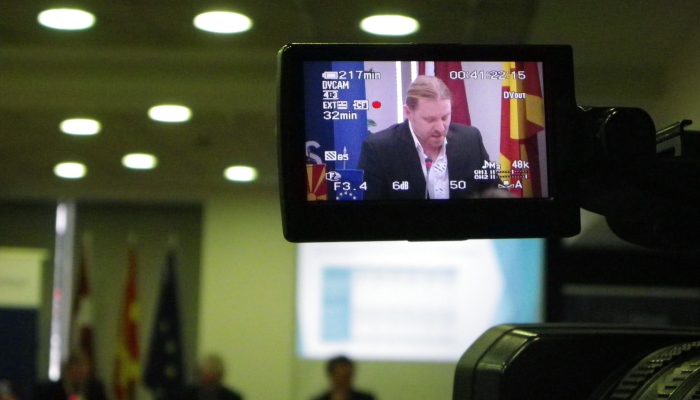
Today, 21 January 2015, the Konrad-Adenauer-Stiftung and the Institute for Democracy “Societas Civilis” – Skopje promoted the study “Public Opinion and Macedonia’s Acession to the European Union 2004-2014” by the author Ivan Damjanovski.
On the promotion we heard the welcoming speeches of Sandra Koljachkova from the Konrad-Adenauer-Stiftung; Marko Troshanovski, President of the Institute for Democracy “Societas Civilis” – Skopje and Robert Liddell, Head of the Department of Political Affairs, Justice and Internal Affairs, Information and Communications of the EU Delegation in Skopje. The presence of the Deputy Prime Minister for European Affairs in the Government of the Republic of Macedonia, Mr. Fatmir Besimi was also announced, but he excused his absence.
In his speech Liddell focused on the reform processes happening in the Republic of Macedonia and its progress towards becoming a full member of the EU, seen through the prism of the EU Country Progress Reports.
When presenting the study, Ivan Damjanovski first started elaborating on the methodology used in the public opinion surveys, which represent the starting point for extracting the conclusions and interpretations in the study itself. In his further exposition, Damjanovski pointed out the following:
– There is a correlation between the dynamics for supporting the EU membership and the advancement of the Macedonian EU accession process, manifested through two indicative time periods: 2004-2009 as a period of consistent and exceptionally high support; and 2010-2014 as a period noting incremental fall in the support of the EU integration process
– The high support for EU membership is primarily due to calculation and faith in the expected material benefits form the EU integration process
– The suggestive functioning of the political elites is confirmed as a factor for the high support of the EU integration process
– The identity factors play a crucial role in explaining the gradual fall in the support of the EU membership in the last five years
– The name issue increasingly deteriorates the interethnic cohesion regarding the perspectives for Macedonia’s EU membership to such an extent that during the last years an increased gap and considerable discrepancies occur between ethnic Macedonians and ethnic Albanians in the support of the EU membership
– The name issue is not essentially manifested as an indicator of the eurosceptic energy. Should this name issue be removed as an influencing factor, then the support for EU membership marks a considerable rise, without significant difference in the ethnic demography
– The myth of the EU attractive power does not lose its potency in Macedonia. The EU membership remains a priority interest for the Macedonian public
The integral text of the study can be downloaded here: 


At the end of the presentation there was an open session for questions and debate, where questions connected to the study and the current socio-political situation in the state had been discussed.
{module EU2014}